Three New Frog Species Discovered—One Honors a Nature and Culture Hero
08/13/2025
Strategic Area:
Biodiversity -
Content Type: News
Country:
Peru -
On the Peruvian side of the Andean Bi-National Corridor, scientists have discovered three new frog species, each named in tribute to the land, its people, and local traditions.
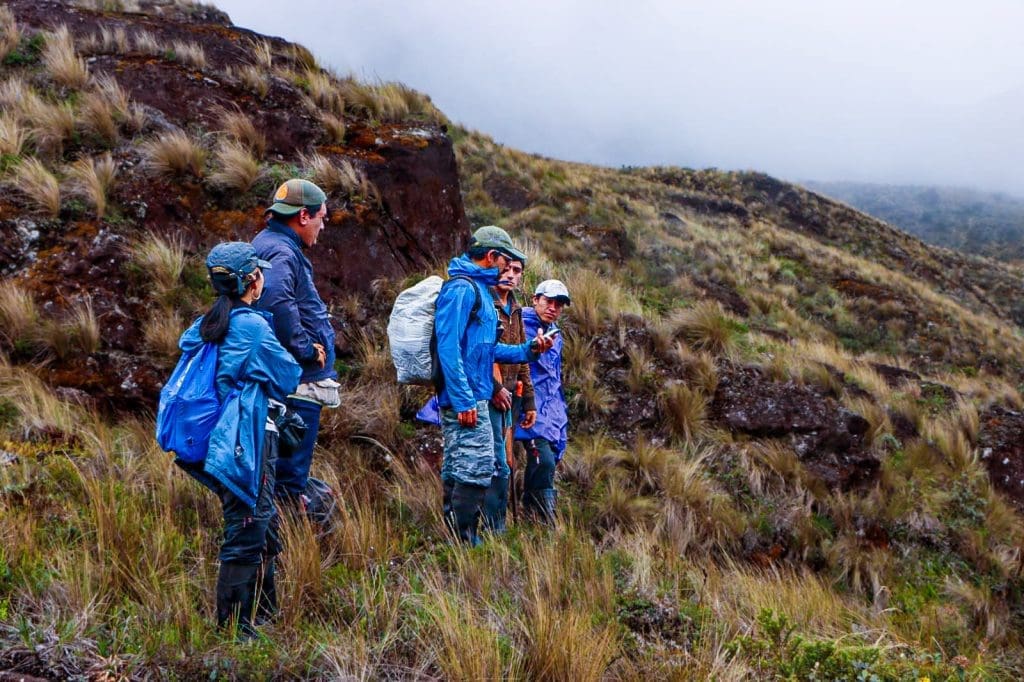
Last month, a team of biologists described three new frog species in the Chicuate Chinguelas Protected Area, a 66,983-acre expanse of páramo and montane forest in Huancabamba Province, Piura. Nature and Culture International helped establish this community-led reserve in 2016, securing a refuge for emblematic wildlife like the spectacled bear and mountain tapir, along with countless species yet to be documented. This protected area is within a vital ecological corridor that links Peru’s mountain forests with those of Ecuador, the Andean Bi-National Corridor.
Chicuate Chinguelas is managed in partnership with the community of Segunda y Cajas, who fought for its creation and continue to safeguard it. For generations, their livelihoods, traditions, and cultural identity have been intertwined with the páramos and forests they now protect—making the reserve both a refuge for rare species and a living expression of the deep bond between people and nature.
The discovery—five years in the making and led by herpetologist Germán Chávez—represents an act of resilience in an ecosystem threatened by fires, deforestation, and resource-based activities such as mining and logging.
“We knew something was waiting for us in the Huancabamba páramos. It wasn’t a complete surprise, but it was an immense satisfaction,” says Germán Chávez. The discovery, published in a scientific article, confirms that this natural area is a prime location for scientific exploration.
The Names Behind the Frog Species
Each of the three newly described frog species carries a name that honors the region. In northern Peru, cutin is a colloquial term for small frogs or toads—a familiar word in rural communities that reflects the region’s connection to its amphibians. Paired with a second descriptor, each name tells its own story.
Pristimantis chinguelasP. nunezcorteziP. yonque
Cutin de Chinguelas(Pristimantis chinguelas) inhabits the Chinguelas Mountain. It is distinguished by long tubercles along the sides of its body—a striking morphological feature that makes it easy to identify. Its name pays tribute to the place where it was found.
Cutin de Elio (Pristimantis nunezcortezi) is a more elusive species, found in the shaded ravines of mountain forests. Its most distinctive feature is the black coloring on the inner thighs, which sets it apart from other frogs in the region. Its name honors conservationist Elio Iván Núñez Cortez, a field technician with Nature and Culture International in Peru and a passionate defender of the Huancabamba mountain range. For more than a decade, Elio has worked to protect the region’s páramos and montane forests—always ready to set out in search of the rarest birds in the area. “Elio knows the land, walks it, protects it, dreams it. It was only right that his name be immortalized in one of its species,” says fellow expedition scientist Iván Wong.
And then there’s Cutin del Yonke (Pristimantis yonke), a frog that lives among bromeliads. Its flattened body, pointed head, and granular texture give it a unique appearance. Its name, far from classical academic terms, is a tribute to a traditional Andean drink: “yonke,” a sugarcane spirit that’s a staple for hikes, camps, and rural celebrations. “We wanted a name that also spoke of the cultural bond with the territory,” explains researcher Iván Wong.
Huancabamba, A Biological Treasure
The Huancabamba páramos, together with the surrounding cloud forests, are part of the Andes del Norte Corridor, which connects with the Andean Bi-National Corridor linking Peru and Ecuador. This continuity explains why the new Pristimantis species have closer genetic ties to their Ecuadorian relatives.
“If you see something on one mountain, you can’t assume it’s on the next. That’s why we’ve decided to walk it all—every ridge, every slope. We want to make sure no centimeter goes unexplored,” says researcher Wilmar Aznaran.
These new species live in a fragile environment, threatened mainly by seasonal fires set to clear fields for crops and pasture—a long-standing farming practice in the region. While currently under control, these burns remain a persistent shadow over a landscape whose unique geological history means it cannot be fragmented without losing irreplaceable species.
“The ecosystem doesn’t respect political borders. We can’t assume that if we destroy one ridge, the same species is safe on the next. That’s a mistake,” warns scientist Karen Victoriano.
Beyond the Lab: Science with Identity
The research team embraces a science that is close to and sensitive to local culture. From naming a frog after yonke to involving community members in fieldwork, the message is clear: protecting biodiversity also means recognizing the people and traditions that have coexisted with it for centuries.
“We want people to feel proud knowing that these species exist in their land, because they’re part of their identity, their history—and now, their future.”
Germán Chávez
Partners in Discovery
This research was made possible through the dedication of herpetologists Germán Chávez, Wilmar Aznaran, Iván Wong, Karen Y. Victoriano-Cigüeñas, Luis A. García-Ayachi, Juan D. Valencia-Málaga, Jesús R. Ormeño, Michael Gulman, Ronal Sumiano-Mejía, Michelle E. Thompson, and Alessandro Catenazzi.
Fieldwork in remote areas like Chinguelas Mountain would not have been possible without local allies such as Angie Meléndres and Eswin Jibaja, who opened trails and offered hospitality. Support came from Nature and Culture International, the Chicago Board of Trade Endangered Species Fund, the E.O. Wilson Biodiversity Foundation, Consultants in Nature and Development (CANDES), Cafetería Pajarero, Restaurante La Cortez, and many friends.
Special recognition goes to the community that championed the creation of the Chicuate Chinguelas Protected Area—today a refuge not only for biodiversity, but also for the promise of future discoveries.