

New Species of Glass Frog Discovered in the Andes
09/05/2024
Research in the Key Biodiversity Area (KBA) of Abra de Zamora uncovered a new species of glass frog within Nature and Culture’s San Francisco Reserve.
The glass frog, belonging to the Centrolenidae family, is named for its translucent skin, which makes its internal organs, including its beating heart, visible. Recent research has shown that what was once thought to be a single species are actually several distinct species, each with differences in appearance, vocalizations, and even genetics.
Researchers from the Technical University of Loja described two new species within the C. buckleyi amphibian group, and the findings were published on August 20th, 2024. The Marco Reyes’ Glassfrog (Centrolene marcoreyesi) was found in Nature and Culture’s San Francisco Reserve in the southern Andes of Ecuador.

Although glass frogs are found across the tropics of Central and South America, recent studies have shown that the highest concentrations are in the Andean region, an area with incredibly rich biodiversity. Most Andean glass frogs have very limited distribution, but Buckley’s glass frog (Centrolene buckleyi) is an exception. This species covers a large region in the tropical Andes. Species that cover such wide areas often turn out to be groups of similar species, especially in complex regions like the Andes.

This first specimen of C. marcoreyesi was identified in 2012 at Nature and Culture’s San Francisco Research Station (SFRS) in the Zamora Chinchipe province in Ecuador. SFRS is part of Nature and Culture’s founding story, and home to the world’s largest tropical montane forest ecology research program. 667 scientific publications have been generated from research conducted here and our team continues to partner with Ecuadorian and German university counterparts to implement ongoing research in the region.
Field Herpetologist Paul Székely noted that unfortunately, this species might already be extinct where it was initially discovered. Recent research, however, has found C. marcoreyesi in three additional locations, including Nature and Culture’s San Francisco Reserve and Podocarpus National Park. Székély believes that these populations are healthy and is currently conducting monitoring to gather data on this endangered species. Due to its limited range, researchers estimate that only a small number of individuals remain and recommend classifying it as Endangered (EN) according to IUCN criteria.

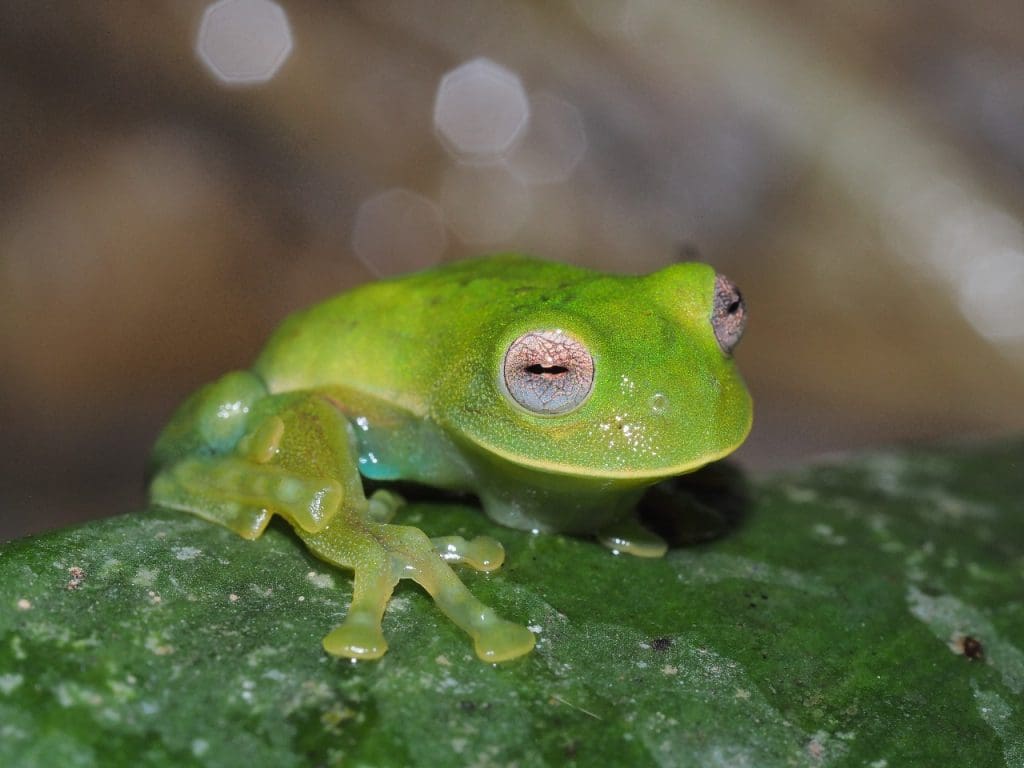

C. marcoreyesi is described as having a lavender tint to its eyes and a clear belly. The species name “marcoreyesi” is a Latin term used to honor Marco M. Reyes-Puig, a well-known herpetologist from the National Institute of Biodiversity in Ecuador, paying tribute to his work and memory, as well as to his family and friends. Marco first collected this new species during a field trip to the Ecuadorian province of Zamora-Chinchipe.
Although species such as this one face the ongoing threat of habitat loss from cattle farming, invasive species, and mining, it is crucial that our protected areas allow biodiversity to thrive. The protection of the San Francisco Reserve would not be possible without the invaluable support of Rainforest Trust whose collaboration has been instrumental in conserving this Key Biodiversity Area. The research team included Daniela Franco-Mena, Ignacio De la Riva, Mateo A. Vega-Yánez, Paul Székely, Luis Amador, Diego Batallas, Juan P. Reyes-Puig, Diego F. Cisneros-Heredia, Khristian Venegas-Valencia, Sandra P. Galeano, Jaime Culebras and Juan M. Guayasamin.
For more information:
Kristen Heard
Director of Marketing and Communications
