

The Ikitu people and the path to reclaiming their culture
03/14/2024
In the heart of the Peruvian Amazon Rainforest lies the community of the Indigenous Ikitu people. Nature and Culture International has established a longstanding relationship with this community located east of the capital city of Loreto, Iquitos. Recently, Milton López, a local communicator for Nature and Culture, journeyed to speak with Marcelo Inuma, the great-grandson of the last chief of the Ikitu people.
According to Peru’s Ministry of Culture, there are just 693 Indigenous Ikitu individuals left in all of Peru. An elder from the Ikitu community lamented that since the passing of their last Kuraka, or chief, in 1940s, the Ikitu have gradually lost touch with their identity and traditional customs due to the encroachment of loggers and land traffickers. Today, they are striving to reclaim their heritage through the strengthening of local organizations and community governance. Nature and Culture International is backing their initiative to revitalize their culture.
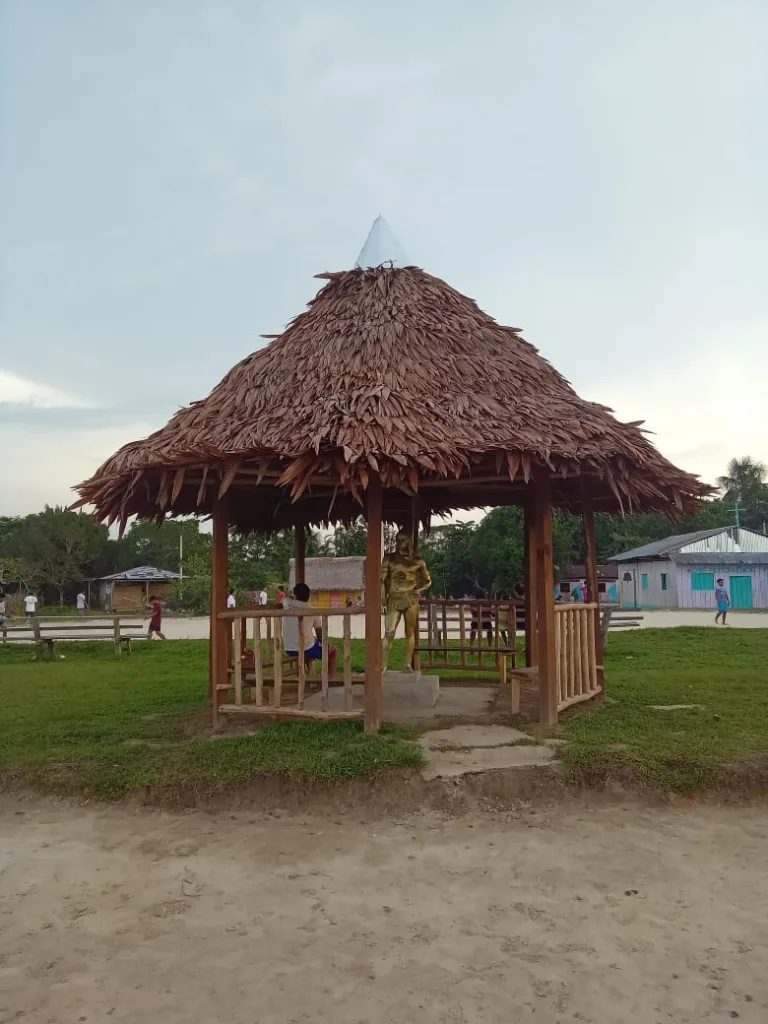
While gathering the last irapay leaves for the new hut that will house an Ikitu statue, Marcelo Inuma, an elder from the San Antonio de Pintuyacu Native Community shares, “I am of Ikitu descent; my great-grandfather was Súkani. He was a very powerful man. Invincible.” The sculpture has been part of the community since 1987, but it was abandoned and began deteriorating due to exposure from the elements. Building a hut for the sculpture marks the beginning of a series of activities through which the Ikitu people are striving to reclaim their Indigenous identity in San Antonio.
Preserving cultural heritage for indigenous communities is integral to our conservation efforts. It is essential for building community resilience to encroaching extractive activities and the effects of climate change. It helps to sustain biodiversity, maintain ecological balance, and promote sustainable resource management because Indigenous communities possess traditional knowledge and practices that have been developed over generations for living in harmony with their natural environment.
The Ikitu and a colonialist past
Marcelo Inuma recalls his ancestry as the great-grandson of the last kuraka of the Amazonian Indigenous Ikitu people. According to the Ministry of Culture’s Indigenous Peoples Database, the Ikitu inhabited the Nanay, Pintuyacu, and Chambira river basins in the Loreto region for centuries. However, in the 17th and 18th centuries, Jesuit missionaries forced them to evangelize. Between 1740 and 1767, their populations were consolidated into eight designated settlements or missions. One of these concentrated settlements was San Pablo del Napeano, later known as the Settlement of the Ikitu, which eventually lent its name to the present-day capital of Loreto, Iquitos.
In 2022, Nature and Culture backed the development of a bilingual graphic novel (in Spanish and Ikitu) titled “The Last Kuraka.” The comic tells the tale of Súkani, the renowned leader of the Ikitu people who was captured by colonial traffickers aiming to take control of their land.

A cultural revival of the Ikitu
“We planned to build this hut as a community. The statue of César Paico is already here; we had it, but it was abandoned. Now that the hut is built, we are going to place the statue beneath it, for everyone to see. Here, people can also rest, this little shelter is going to have all the comforts for our community,” adds Marcelo Inuma, who was also a community leader or “apu” of San Antonio, situated in the Pintuyacu basin.
Confronted with the loss of their ancestral knowledge, the elders and leaders of the Ikitu community in San Antonio, along with their political representatives, decided to form a Culture Committee. Marcelo Inuma is a member of this committee, tasked with the important responsibility of gathering and preserving songs and cultural artifacts. In doing so, he plays a role in revitalizing the rich cultural legacy passed down by his great-grandfather, Súkani.
Other members of the committee include Inés Pacaya Inuma (Historian); Silvia Díaz Saboya (Dance and Traditional Clothing); and Nelson Pacaya Inuma (Bilingual Hand-Lettering Specialist).
Nature and Culture collaborated with the Culture Committee to create a comprehensive plan aimed at reclaiming Ikitu culture and reinvigorating the use of their language. This plan includes various strategies to ensure that the entire community embraces the Ikitu language and culture once more. These strategies involve organizing instructional workshops, providing bilingual teachers and Ikitu learning materials to the community’s children to help them become proficient in their native language, and broadcasting radio programs about their people to raise awareness of their cultural significance among the population of Loreto.
In the long journey of recovering Ikitu knowledge in San Antonio, the responsibility falls not only on the Culture Committee but also on the entire community. For example, another advocate for Ikitu culture is César Paico Llona, who, at 17 years old, served as the model for the very sculpture now housed in the hut. Crafted by artist Felipe Lettersten in 1987, the sculpture symbolizes the community’s dedication to preserving their heritage.

Ancestral knowledge for future generations
Despite being one of the most recognized Indigenous groups in the Peruvian Amazon, the Ikitu population is still among the most vulnerable and least populous. The situation is compounded by the fact that very few people speak their language. According to a national census from 2017, only 519 individuals reported speaking the Ikitu language.
However, this was not always the case. In the year the Ikitu statue was built, the situation was different. “We’re talking about 1987. More people spoke Ikitu back then. San Antonio was much smaller, the area behind it was not inhabited, and the main port that exists today did not exist, nor did the staircases; they were elsewhere. It was common knowledge that there was a statue and that it was tucked away. Originally, I personally erected it to be at the port,” recalls César Paico.
On October 12th of last year, Nature and Culture supported the Fourth Amazonian Ancestral Knowledge Gathering in Iquitos, an event that brought together elders from seven Indigenous Peoples of Loreto. At this gathering, Marcelo Inuma and his niece Margarita Beuzeville were present and the Ikitu elder shared his story: “I come from a mother who spoke Ikitu and understood Spanish, and grandparents who spoke Ikitu exclusively. My grandfather never spoke Spanish. I was raised speaking the language and using natural medicines with them. No one was ever lacking during their “minga” (collective work). Everyone shared.”
Currently, in the Ikitu village, only two wise men are recognized by the Peruvian state. “But they are already old; they are over 70 years old. I am left as the only wise man and interpreter-translator of this language. I write, speak, translate. What we want is to revitalize all these customs we had before, and for me not to be alone,” concludes the wise Marcelo Inuma.
Communal authorities and Ikitu wise men hope that with the realization of the various mentioned activities such as teaching Indigenous culture and language, the production of bilingual materials, and the revitalization of the language through radio transmission, Peru and the world will learn about the existence and importance of the Ikitu in the past, present, and future of national history.
